Toward Accelerated and More Accurate Objective Fitting: Integrating Multi-Latency Measures of Auditory Processing in Cochlear Implant Patients
Project Co-Lead: Dorothée Arzounian
Cochlear Implants provide a sense of hearing to d/Deaf individuals by directly stimulating their hearing nerve. Each implanted patient has a unique story and hearing status, requiring clinicians to perform major adjustments to stimulation settings for individual cases. Finding the best settings is challenging and time consuming, as there is no good way to check how people hear with different settings: the results typically rely on the ability of the patient to describe the sensations provided by the implant. Of course, the process is even more challenging when the patient cannot actively engage with the clinician. Yet, many children who are born deaf receive cochlear implants in the first year of life, before they are able to communicate reliably. Therefore, the imperfection of device programming probably prevents many from reaching the best possible speech perception, which may explain why satisfaction and objective outcomes vary a lot from person to person.
To maximize chances for all patients to fully benefit from their implant without overburdening medical staff, we need new ways to tailor device settings to the specific needs of individual patients quickly and without requiring patient communication. The results so far might be limited because previous attempts focused on individual measurements that captured the response from a restricted region of the brain.
In this project, we record responses from three parts of the brain simultaneously – the hearing nerve (depicted in green in the image to the right), the brainstem (depicted in purple), and the cortex (depicted in orange).
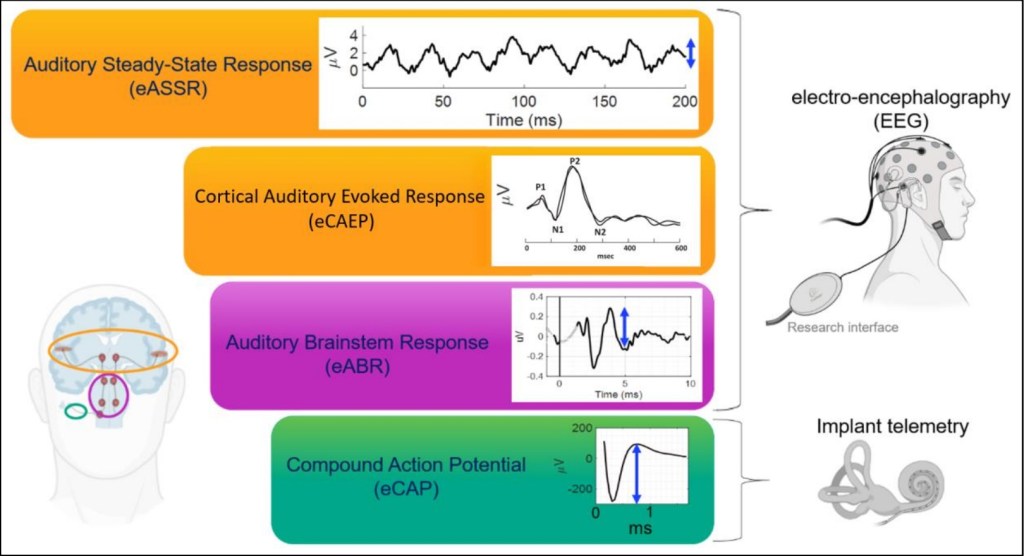
By studying how the full pattern of brain responses relates to the loudness perceived by the patient, we plan to develop a tool that clinicians can use to program the intensity of stimulation appropriately in individual patients’ devices, ultimately helping them reach their hearing potential and more easily engage with the auditory world around them.
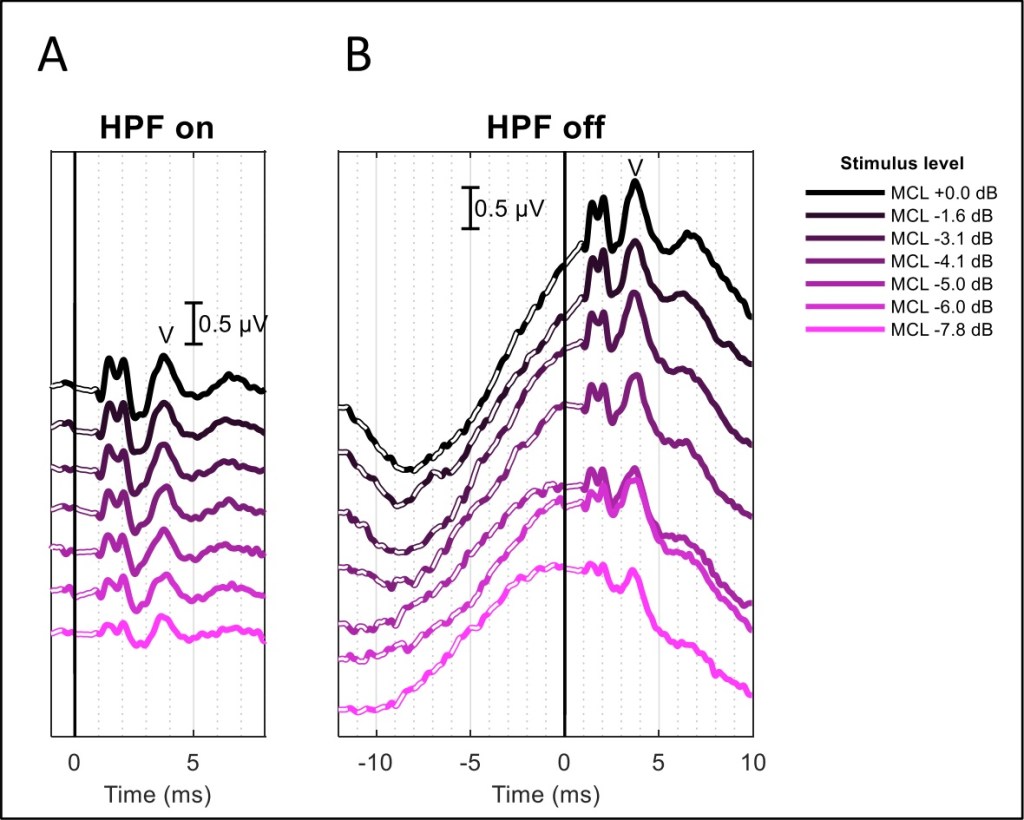
We already have evidence that it is possible to simultaneously record electrically evoked auditory brainstem responses (eABRs) and electrically evoked auditory steady-state responses (eASSRs). These are electrophysiological measurements from the brainstem and the thalamus, respectively, and are recorded using a hyper-rate (262kHz) electroencephalography (EEG) system that allows blanking of the electrical artefacts from the cochlear implant.
This project is ongoing, and will investigate possibility of predicting behavioural threshold and comfort levels using a combination of eABRs, eASSRs, electrically evoked compound action potentials (eCAPs, recorded using reverse telemetry within the cochlear implant itself and a reflection of the response of the auditory nerve), and electrically evoked cortical auditory evoked potentials (eCAEPs, an onset response from the cortex recorded using EEG).
Acknowledgements
We are very pleased that this work is being supported by the Royal National Institute for Deaf People (RNID) through an Innovation Seed Fund Award (ISF25/13 to Arzounian & Garcia).


We will also be collaborating with Clément Gaultier at the Institut Pasteur in Paris, as well as with François Guérit within the University of Cambridge.
References
Arzounian, D., Guérit, F., Deeks, J. M., Garcia, C., de Groote, E., Bance, M., & Carlyon, R. P. (2025). Measurement of phase-locked neural responses to cochlear-implant stimulation from multiple stages of the auditory system. Hearing Research, 464, 109338. https://doi.org/10.1016/j.heares.2025.109338
 Charlotte Garcia