ALternating Frequency Interleaved Electrical Stimulation (or ALFIES) is a method for recording cortical responses to high-rate, amplitude-modulated pulse trains in cochlear-implant users. The technique uses two interleaved, amplitude-modulated current-pulse trains, and allows for extraction of the neural response from electrical stimulation artefacts within the recording. The amplitude modulation is nominally at 80 and 120 Hz, and smoothing and nonlinearities in the auditory system give rise to a neural distortion product at 40 Hz. Importantly, the linearity and instantaneous nature of the electrical artefact do not give rise to distortion, and so the signal at the distortion product frequency is generally free of artefact.
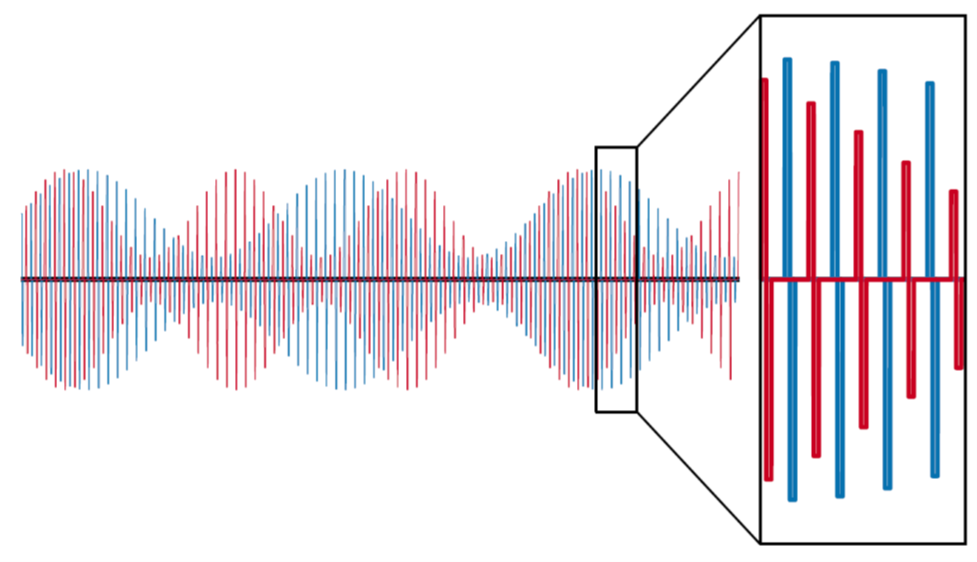
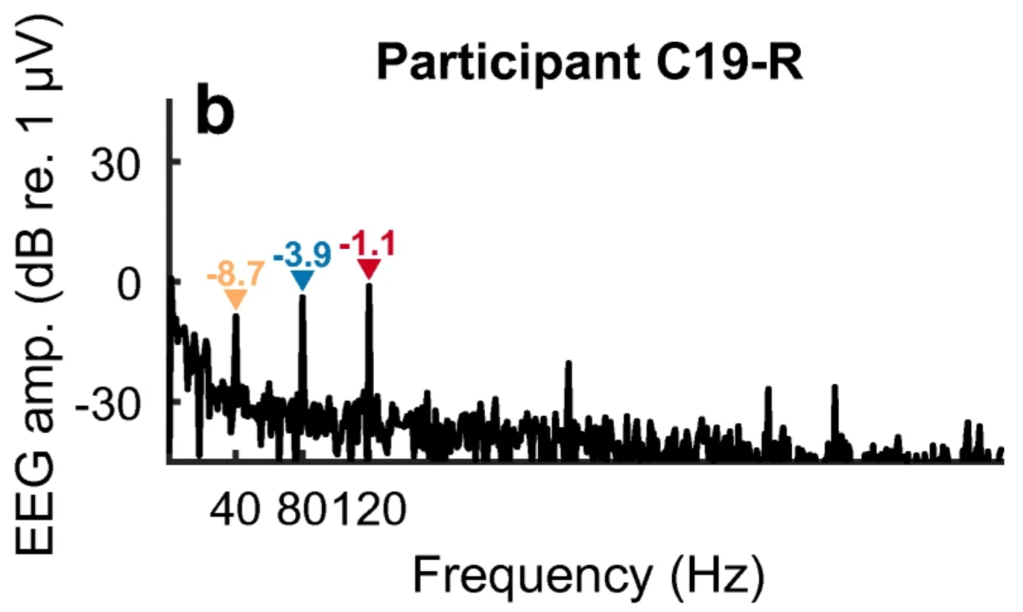
This technique allows for an electrophysiological cortical measure in cochlear-implant users in response to high-rate, amplitude modulated pulse trains, and this is important because most other electrophysiological measures are recorded at low stimulation rates to avoid the influence of the electrical artefact. Because ALFIES uses stimulation that is more similar to that used in cochlear-implant users’ day-to-day listening, it may be more representative of behavioural perception of loudness than other techniques. Guérit et al (2023) have already shown that the amplitude of the response at the distortion product grows steeply with stimulus amplitude and for many cochlear-implant users, changes by at least 12 decibels within the loudest 25% of their dynamic range. It is therefore a good candidate for use in objective/automatic fitting of cochlear-implant processor settings.
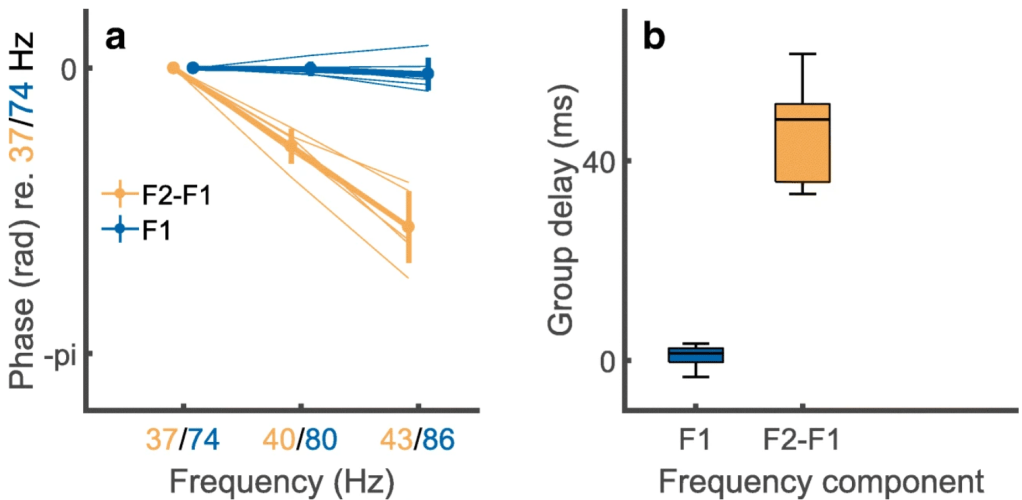
We have been able to demonstrate that this response is – in fact – neural and not electrical artefact by observing phase shifts with different stimulation rates to quantify group delays of the responses. These delays of the distortion product response are consistent with generators in the thalamus/cortex.
My own work on this project has focused in a few directions, namely asking questions about how the method might be optimised for clinical translation. I have shown that the distortion products are a combination of quadratic (F2-F1) and cubic (2*F1-F2) distortions (Garcia et al 2023, 2024) and that combined response is moderated by the relative starting phases of the F1 and F2 amplitude modulation. I have also shown that in a few patients, it may be possible to record ALFIES responses with reverse telemetry using the hardware of the cochlear-implant electrodes itself (Garcia et al 2024). Using some computational modelling (Guérit et al 2025) as well as investigating the effects of alternating the leading polarity of stimulating pulses, we are currently asking questions about the relative roles of facilitation and refractoriness in generating the response, building on previous work from Guérit et al (2023) that suggests the integration of the two amplitude-modulated pulse trains occurs as early as the auditory nerve. This work is ongoing, and is all with an aim to optimise and motivate the technique for use in clinical settings.
Acknowledgements

This project has primarily been funded through a Collaborative Wellcome Award (RG91976 / 209243) to Robert P Carlyon (University of Cambridge, UK), Jan Wouters (KU Leuven, Belgium), and John Middlebrooks (UC Irvine, USA). This funded sequential post-doctoral positions at the MRC Cognition & Brain Sciences Unit, Cambridge, for my colleague François Guérit and for myself between 2018 and 2024.
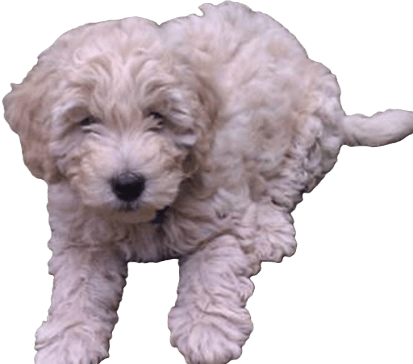
It is of the utmost importance to mention that while we cannot thank him for any intellectual or financial contribution to the project, significant thanks goes nonetheless to Alfie (Bob Carlyon’s dog, see right) for inspiration.
References
Guérit, F., Deeks, J. M., Arzounian, D., Gransier, R., Wouters, J., & Carlyon, R. P. (2023). Using Interleaved Stimulation and EEG to Measure Temporal Smoothing and Growth of the Sustained Neural Response to Cochlear-Implant Stimulation. Journal of the Association for Research in Otolaryngology: JARO, 24(2), 253–264. https://doi.org/10.1007/s10162-023-00886-2
Carlyon, R. P., Guérit, F., Deeks, J. M., Harland, A., Gransier, R., Wouters, J., de Rijk, S. R., & Bance, M. (2021). Using Interleaved Stimulation to Measure the Size and Selectivity of the Sustained Phase-Locked Neural Response to Cochlear Implant Stimulation. Journal of the Association for Research in Otolaryngology, 22(2), 141–159. https://doi.org/10.1007/s10162-020-00783-y
Manuscripts in Preparation:
Garcia, C., Guérit, F., Arzounian, D. and Carlyon, R.P. (in prep).
Optimising ALFIES: the contribution of multiple distortion products, effect of starting phase and of alternating polarity on cortical responses to sustained high- ate stimulation in cochlear implants with electroencephalography and reverse telemetry.
Conference Posters:
Garcia, C. (2025, February). ALFIES unwrapped: Recording cortical responses to sustained high-rate stimulation in cochlear implant users. Midwinter Meeting of the Association for Research in Otolaryngology, Orlando, Florida, USA. (view here)
Garcia, C., Arzounian, D., Guérit, F., Deeks, J. M., & Carlyon, R. P. (2023, July). Towards using cochlear implant electrodes to record cortical responses to sustained high-rate stimulation. (view here)
Accepted Conference Paper:
Guérit, F., Garcia, C., & Carlyon, R. P. (2025, June). Modelling of distortions created by temporal interactions between pulses in CI users. Forum Acousticum Euronoise, Malaga, Spain.
 Charlotte Garcia